

Three steps into a braise — onions already soft, wine already reduced — I reached for the tomato paste and found the crumpled empty tube at the back of the drawer. No time for a grocery run, so I dug through what I actually had. A can of crushed tomatoes, a bottle of ketchup, half a jar of roasted red peppers. Most of those work. A couple of the swaps you’ll see recommended online don’t. This list is what holds up, with the ratios written down so you never have to figure it out mid-cook again.
By the end of this you’ll have a one-page reference for every tomato paste swap that earns its place, and it takes about 10 to 15 minutes to set up the one that matters most. Print it, fold it, keep it in the drawer where the tubes live.
How this list works
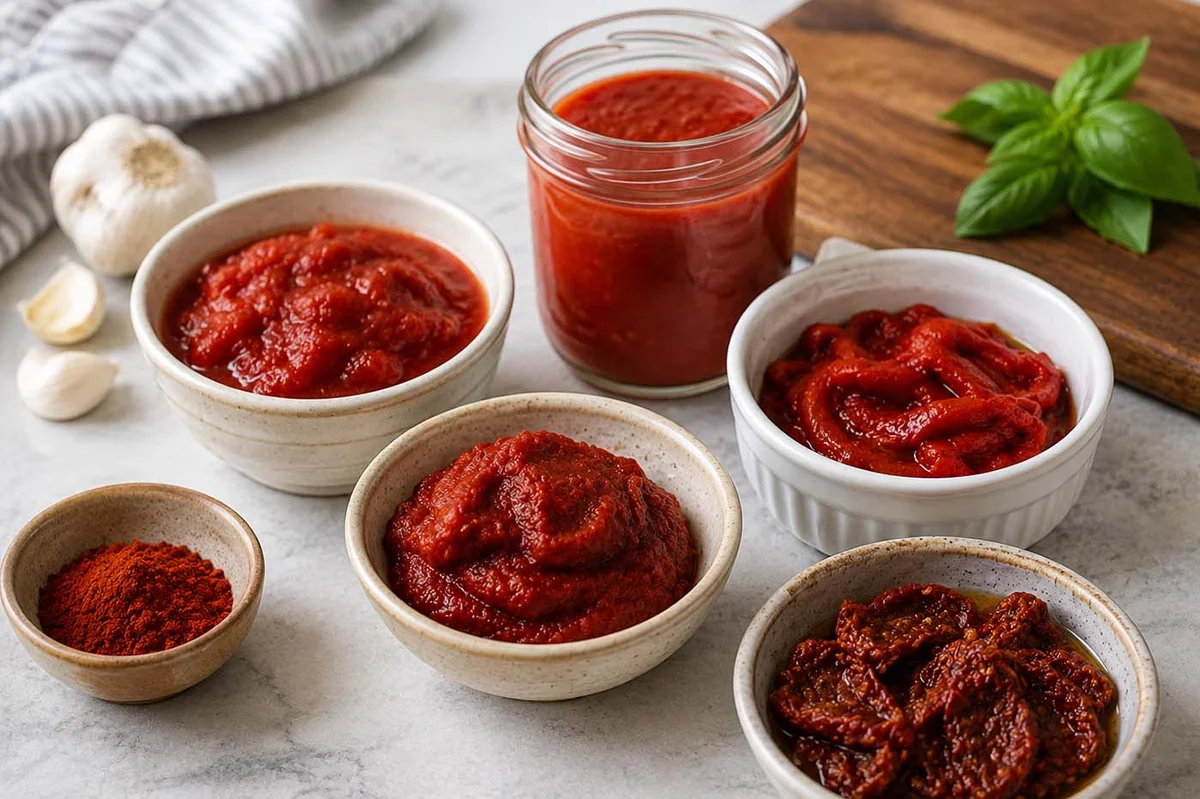
It covers the nine substitutes that genuinely work, grouped by the job you’re trying to cover: the all-purpose fix, the fast fixes, the from-scratch options, and the no-tomato swaps. Every line gives the ratio so you can measure out and go. Assume a home kitchen, a recipe that calls for a tablespoon or two of paste, and no trip to the store.
What the paste is actually doing
Before you swap anything, know the job, because a good stand-in has to cover it. Paste is tomatoes cooked down until at least 24 percent of it is tomato solids, under the FDA’s standard of identity for tomato concentrates, while puree and sauce sit in the 8 to 24 percent range. That gap is why a single tablespoon can do three things at once, and why your swap has to match the job, not just the color.
- Savory depth — the umami richness that thin tomato products simply don’t carry; a reduced swap comes closest.
- Bright acidity — what balances a fatty braise or a rich stew; ketchup and peppers each change this balance in their own way.
- Body — thickening by taking up space without adding much water; the nightshade-free options below handle this job on their own.
The all-purpose fix
- Tomato sauce or puree, reduced — simmer 3 tablespoons down to 1 tablespoon of paste, about 10 to 15 minutes; the closest match in flavor and texture, and the one to start first because it needs time.
- Canned crushed or diced tomatoes, reduced — simmer 3 to 4 tablespoons until the liquid mostly evaporates, then blend smooth; takes a bit longer than sauce, but it’s the swap most likely to already be in your pantry.
- Tomato powder or bouillon, reconstituted — mix about 1 tablespoon of powder with 2 teaspoons of hot water and adjust, since brands vary; the shelf-stable backup that never spoils like an opened can.
The fast fixes
- Ketchup — 1:1, and the fastest fix when a recipe calls for a tablespoon or two, like a glaze where a little sweetness is already welcome; for larger amounts, trim the other sugar and vinegar in the recipe.
- Roasted red peppers, pureed — 1:1, with a splash of vinegar or lemon juice for the acidity it can’t bring; deep red color and a mild smoky sweetness, though peppers are nightshades too, so it’s not the answer for a nightshade-free kitchen.
The from-scratch options
- Fresh tomatoes, cooked down — one medium tomato, peeled and seeded, simmered gently for 20 to 30 minutes yields about a tablespoon of paste; takes the longest but tastes fresh and bright instead of cooked-down.
- Home tomato paste, frozen for later — freeze paste in tablespoon-sized portions on a lined tray, then bag the frozen pieces; most recipes only need a tablespoon or two, and this is the easiest way to never be caught out again.
The no-tomato swaps
- Pumpkin or butternut squash puree plus vinegar — 1:1 with a splash of vinegar per tablespoon and a pinch of salt; genuinely nightshade-free, handles the thickening job, but tastes nothing like tomato, so pair it with the seasonings the recipe calls for.
- Beet puree — start with about 1 teaspoon per cup of sauce and adjust; brings back the deep red color with no nightshade content at all, and it works best paired with the squash puree rather than used alone.
- Sun-dried tomatoes, blended — 2 oil-packed halves blended per tablespoon of paste; technically still tomato, but the most concentrated flavor on this list, and it’s the right call for long braises and marinades where that intensity is a feature.
Quick reference by job
- Closest overall match — reduced tomato sauce or puree, 3:1 then reduced, 10 to 15 minutes.
- Fastest small-amount fix — ketchup, 1:1.
- Deep flavor in a long braise — blended sun-dried tomatoes, 2 halves per tablespoon.
- Only fresh tomatoes on hand — cooked down, 1 tomato per tablespoon, 20 to 30 minutes.
- Nightshade-free thickness — pumpkin or squash puree, 1:1 plus vinegar.
How to use it this week
- Buy first: nothing — every swap on this list lives in a stocked pantry, which is the point.
- Prep first: set the sauce or puree reducing as soon as you start a recipe that needs it, since 10 to 15 minutes is the longest wait here.
- Keep the reduced paste you make in small jars; it keeps a week or two in the fridge and saves you the next time.
- Print this list and tape it inside the cabinet where the paste tube lives. Future-you is mid-braise and won’t be reading a screen.
Make it yours
- No nightshades at all? Use the squash puree for body and a little beet puree for color, and lean on your herbs for the flavor the tomatoes would have brought.
- Scaling up for a big batch? Double the 3:1 reduce — it doesn’t change, only the time does.
- British recipe calling for tomato purée by the tablespoon? That’s paste in US terms, so treat it exactly like the paste line here.
FAQ
Can I use ketchup instead of tomato paste? Yes, 1:1, for small amounts. It already contains sugar, vinegar, and salt, so it works where those flavors blend in, and you trim the rest of the recipe’s sugar and acid for larger amounts.
Is tomato puree the same as tomato paste? Not in the US — American puree is thin, in the 8 to 24 percent solids range. British “tomato purée” is the thick tube product Americans call paste, so a British recipe’s tablespoon of purée means a tablespoon of paste.
How much sauce equals a can of paste? The reverse ratio: one standard 6-ounce can of paste whisked with about 1 cup of water gets you close to a 14 to 15-ounce can of sauce. Simmer a few minutes and it tastes cooked together instead of diluted.
Can I freeze tomato paste? Yes — freeze leftover paste in tablespoon portions on a lined tray, then transfer the solid pieces to a bag. It’s the easiest way to skip the substitute next time.
Happy cooking, Maya.
1 Comment